
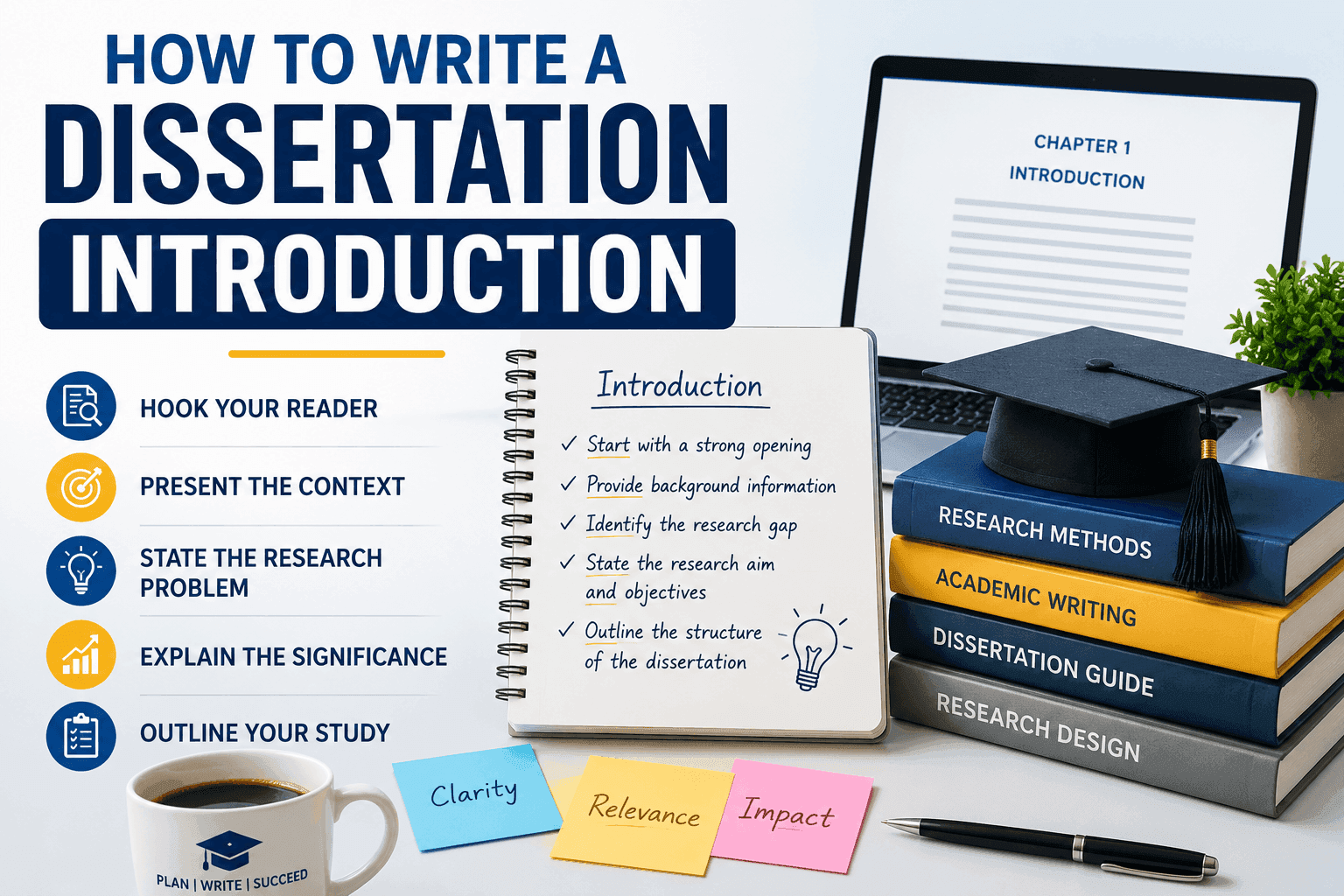
How to Write a Dissertation Introduction
Every student, once in their life, has experienced staring at a blank page for hours, thinking, “Where do I even start?” while writing a dissertation.
You type a sentence, delete it and maybe type again. The feeling of exhaustion trips up nearly every student, especially when you’re not sure what your professor expects.
But don’t worry, it’s not as complicated as it looks.
So what’s the problem? The only problem is the structure. Once you understand it, everything becomes much easier. And that’s what you are going to learn in this blog.
Keep reading to fix that incomplete introduction you have been trying to write for hours.
Everything You Should Know About a Dissertation Introduction
The introduction of your dissertation is the very first section of your dissertation that every student should focus on the most.
Unlike what most students think, it is not merely background information. It tells the reader what you are researching, why it is important and how you plan to explore it all.
You can think of it like a trailer of a film, if it is boring, no one watches the movie, right?
Just like that, if you are unable to hook the reader from your introduction, whether written on your own or when you hire someone to write my dissertation, chances are the reader has already made his mind about your dissertation.
Because most examiners form an early impression of your dissertation from the introduction alone.
The Length of a Dissertation Introduction
“How long is too long?” is one of the most common questions students ask.
As a general rule, your introduction should make up roughly 10% of your total word count.
So, for a 10,000-word dissertation, you are looking at around 1,000 words.
Check the rest of the word count in the table below:
| Dissertation Length | Intro Word Count |
| 5,000 words | ~500 words |
| 10,000 words | ~1,000 words |
| 15,000 words | ~1,500 words |
| 20,000 words | ~2,000 words |
Step-by-Step Guide to Writing a Dissertation Introduction
Here’s what every strong dissertation introduction needs:
1. Background Context
Provide a background context in a conversational way. Introduce the topic in two or three sentences. Then gradually narrow it down to your specific focus.
For example, if you are writing about mental health in UK universities, you might start by talking about the rising mental health crisis among young people, then write on university students specifically, like:
“Mental health challenges among young people in the UK have increased significantly over the past decade. Within higher education, this trend has become particularly alarming, with universities struggling to meet growing demand for support services.”
2. Researching the problem
This is where many students get stuck. A research gap is something that hasn’t been studied enough yet. Your dissertation fills that gap. Once you find answers to the questions that aren’t available anywhere, you can state them like:
“Despite growing interest in this area, limited research has explored [your specific angle]. This dissertation addresses that gap.”
3. Aims and Objectives
Aim is what you want to achieve overall. The objectives are the smaller steps, or actions, that will help you achieve that aim.
Explain in simple terms:
The aim is to investigate the impact of SNS on the mental health of the students of the United Kingdom universities.
Objectives:
- To review existing literature on social media use
- To look at previous research on social media use
- To gather information from students via online surveys
- To analyse patterns and draw conclusions
4. Research Questions
You must add your research questions to your dissertation that should be clear, specific and answerable through the methodology you chose.
Here’s how you can differentiate between a strong and a weaker one:
Good research question: “How does excessive social media use affect the mental health of undergraduate students at UK universities?”
Weak research question: “Does social media affect students?”
The Struggle to Get Started
Have you found yourself sitting there, thinking, “I just can’t do this”? It doesn’t mean you’re not capable. It happens because of exhaustion. In this situation, using a dissertation writing service UK can help you get back on track.
This professional support helps many students throughout the process. Just keep in mind that it doesn’t replace your work, and there is no shame in asking for help.
Fun fact: A strong dissertation introduction can improve your overall grade by up to 20% because it shapes first impressions.
Common Student Struggles (and How to Fix Them)
- “I don’t even know where to start.”
Just open a blank document and write one terrible sentence. That’s literally all it takes. You can always edit or change it later.
- Staring at the same paragraph for 45 minutes and somehow making it worse.
Close the tab, take a walk, come back fresh. At this point, your brain needs air, not more pressure.
- Feeling like everyone else has it figured out except you.
They don’t. They’re just as lost, and confusion is common. Secondly, you don’t have to compare yourself with anyone, as each student works at their own pace.
Reading the same sentence five times and still having no idea what it says.
Put the book down, drink some water and try again in ten minutes. Your tired eyes won’t be able to read.
- Pulling an all-nighter and producing absolute rubbish anyway.
Sleep for four hours. Four hours of rest beat eight hours of exhausted nonsense every single time.
- Crying in the library because the printer is broken and the submission is due in an hour.
Ask the person next to you. Someone always knows a working printer, and humans are kinder than you think.
Quick Tips to Make Your Introduction Stand Out
If you want your introduction to actually impress your examiner? Try these:
- Start with a compelling statistic or question
- Avoid vague openers like “Since the dawn of time…”
- Keep sentences short and clear
- Signpost each section so the reader knows what’s coming
- Get your theses proofread and edited by a professional Dissertation Abstract Help service
FAQs
How do I write a dissertation introduction for a science dissertation?
For science dissertations, start with the wider field, research the specific problem, state your hypothesis and outline your methodology briefly. Keep the language specific and evidence-based.
How many research questions should I include in my introduction?
Most dissertations include between two and four research questions. They should be specific, researchable and directly tied to your aims and objectives. Avoid having too many as it dilutes your focus and makes the dissertation harder to manage.
Should You Write Your Introduction First or Last?
Many experienced researchers and academics actually write their introduction last, after the entire dissertation is complete. This way, they know exactly what they’ve written and can introduce it accurately.
What is the difference between a Dissertation Introduction and a Dissertation Abstract?
A dissertation introduction explains your topic, why you chose it and what you plan to research. In comparison, a dissertation abstract is a short summary of your entire dissertation. The simple difference is that the introduction sets up your research, while the abstract summarises the whole thing once it is done.
Final Thoughts
Well, now you finally know how to write a winning dissertation introduction? Start by researching and with a clear mind. Once you grasp the structure, it’s all so easy. But when it comes to getting stuck, keep in mind, help is available. It may be a full writing service or perhaps a buddy that is reading through your draft and giving feedback. Seek help when it is needed; it’s not a weakness.

Anthony Hopkins is an academic writer at HelpDissertation.co.uk who has spent years helping students with their research and dissertation projects. He enjoys breaking down complex academic concepts into simple, practical advice, making it easier for students to complete their work with confidence and achieve their academic goals.